Every second counts. A two-second delay in page load time can increase bounce rates by as much as 103%, according to Google. For software products, that stat isn’t just a technical footnote—it’s a direct line to lost revenue, eroded trust, and customers who quietly migrate to a competitor.
Software performance is no longer a back-end concern reserved for engineers. It has become one of the most visible and consequential factors in how customers perceive, use, and stick with a product. When software runs fast and reliably, users barely notice it. When it doesn’t, they notice everything.
This post explores the relationship between software performance and customer experience, why retention hinges on it more than most teams realize, and what organizations can do—through rigorous software testing, ongoing software analysis, and smart software features—to build products that customers keep coming back to.
What Does Software Performance Actually Mean?
Software performance refers to how efficiently and reliably an application operates under various conditions. It encompasses several measurable qualities:
- Speed: How quickly the software responds to user inputs or completes tasks
- Scalability: How well the system handles increases in users or data volume
- Stability: How consistently the software functions without crashes or errors
- Resource efficiency: How effectively the software uses CPU, memory, and bandwidth
These aren’t abstract metrics. Each one maps directly to a real user interaction. Slow load times frustrate users during onboarding. Poor scalability causes outages during peak traffic. Instability destroys trust at the worst possible moments—like during a checkout flow or a live presentation.
High-performing software doesn’t happen by accident. It’s the product of deliberate software testing, continuous software analysis, and thoughtful decisions about which software features to prioritize and how to build them.
How Does Slow Software Performance Hurt Customer Experience?
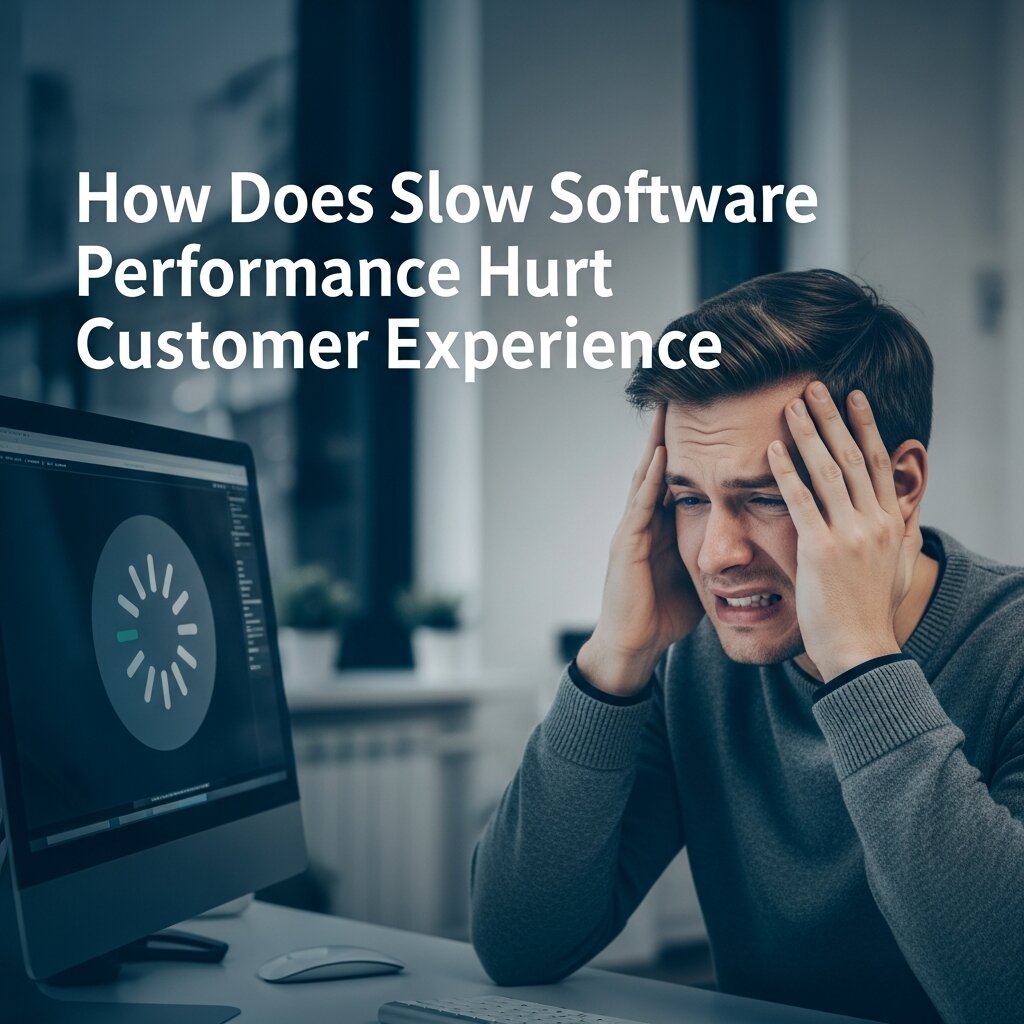 The modern user has no patience for lag. Research from Forrester shows that a one-second delay in response time can reduce conversions by 7%. When users encounter friction—slow screens, unresponsive buttons, loading spinners that spin indefinitely—their experience shifts from productive to frustrating.
This frustration has a compounding effect. Users who experience performance issues are more likely to:
- Abandon the task they were completing
- Leave negative reviews that influence future buyers
- Contact support, which increases operational costs
- Stop using the product altogether
The emotional impact of poor software performance is often underestimated. Users don’t just get annoyed—they lose confidence in the product and, by extension, in the company behind it. Trust, once broken, is hard to rebuild.
On the flip side, software that performs well creates a kind of invisible satisfaction. Users accomplish their goals quickly, without interruption. That seamless experience builds positive associations with the brand and contributes to long-term loyalty.
What Is the Connection Between Software Performance and Customer Retention?
Customer retention is one of the strongest indicators of product-market fit and business health. Acquiring a new customer costs five times more than retaining an existing one, according to data from Bain & Company. Software performance sits at the heart of retention because it directly affects how often users return, how deeply they engage, and how likely they are to recommend the product.
Consider a SaaS platform where users log in daily to complete work tasks. If the platform loads slowly in the morning rush, users begin their day frustrated. Over time, that friction accumulates. What starts as mild irritation becomes a legitimate reason to evaluate alternatives. Churn rarely happens in a single moment—it builds, quietly, through repeated negative experiences.
High software performance, by contrast, reinforces habits. When an app is fast and reliable, it becomes a natural part of a user’s workflow. That kind of embedded utility is extraordinarily powerful for retention.
How Do Software Features Influence Performance and Retention?
Software features are the visible face of a product—the capabilities users interact with every day. But features and performance are not independent variables. Every new feature added to a product introduces complexity, and complexity, if unmanaged, degrades performance.
Teams that prioritize feature velocity over software quality often find themselves in a difficult position: the product has more capabilities, but each one feels sluggish or unreliable. Users don’t experience a product as a collection of features; they experience it as a whole. One slow, broken feature can undermine confidence in the entire application.
The most successful product teams treat performance as a first-class software feature—not a constraint to work around, but a quality to actively design for. This means setting performance budgets, defining acceptable latency thresholds for key workflows, and treating performance regressions with the same urgency as functional bugs.
How Can Software Testing Prevent Performance Problems Before They Reach Users?
 Software testing is the primary mechanism for catching performance issues before they affect real users. Without a structured testing strategy, teams are essentially shipping blind—hoping that the performance holds up in production environments they haven’t fully simulated.
Effective software testing for performance includes several distinct approaches:
What Is Load Testing and Why Does It Matter?
Load testing simulates real-world traffic to understand how software performs under expected and peak conditions. Teams use tools like Apache JMeter, Locust, or k6 to generate thousands of concurrent user sessions and measure response times, error rates, and throughput.
Load testing answers a critical question: at what point does the system start to degrade? Knowing that threshold allows engineering teams to scale infrastructure proactively—before a traffic spike causes an outage that users remember.
How Does Stress Testing Reveal Hidden Performance Risks?
Stress testing pushes software beyond its normal operating parameters to identify breaking points. Unlike load testing, which simulates realistic usage, stress testing is deliberately extreme. The goal isn’t to model typical behavior—it’s to understand failure modes.
When a system breaks under stress, engineers learn where the weaknesses are: a database query that becomes catastrophically slow under load, a memory leak that only surfaces after hours of use, a third-party API integration that times out unexpectedly. Stress testing surfaces these vulnerabilities in a controlled environment rather than in production.
What Role Does Regression Testing Play in Maintaining Software Performance?
Performance regressions—instances where a code change inadvertently makes the software slower—are one of the most common causes of gradual performance degradation. Regression testing involves running a consistent set of performance benchmarks after every significant code change to detect regressions early.
Many teams automate regression testing as part of their CI/CD pipeline, ensuring that performance baselines are checked before any code reaches production. This approach catches problems when they’re cheapest to fix—immediately after they’re introduced.
Why Is Software Analysis Essential for Long-Term Performance Management?
Software testing tells you how a product performs before deployment. Software analysis tells you how it’s performing in the real world, with real users, over time.
Ongoing software analysis involves monitoring application performance in production, analyzing user behavior data, and identifying patterns that signal emerging issues. Key tools in this space include application performance monitoring (APM) platforms like Datadog, New Relic, and Dynatrace, which provide real-time visibility into response times, error rates, database query performance, and infrastructure health.
How Does Real User Monitoring Differ From Synthetic Testing?
Real User Monitoring (RUM) captures performance data from actual user sessions—browser load times, interaction delays, geographic performance variations, and device-specific issues. This data is richer and more representative than synthetic tests because it reflects the true diversity of user environments.
Synthetic testing, by contrast, uses scripted simulations run from controlled environments. Both approaches are valuable, but neither replaces the other. Synthetic tests catch known performance scenarios reliably and consistently; real user monitoring surfaces unexpected issues that only emerge from real-world usage patterns.
What Performance Metrics Should Teams Prioritize During Software Analysis?
Not all performance metrics are equally important to user experience. The industry has converged on a set of user-centric metrics known as Core Web Vitals, introduced by Google, which measure:
- Largest Contentful Paint (LCP): How quickly the main content of a page loads
- Interaction to Next Paint (INP): How responsive the page is to user interactions
- Cumulative Layout Shift (CLS): How visually stable the page is during loading
These metrics matter not only for user experience but also for search visibility, since Google incorporates Core Web Vitals into its search ranking algorithm. Teams conducting software analysis should treat these metrics as primary indicators of product health.
How Can Organizations Build a Culture That Prioritizes Software Performance?
Technical processes alone are not enough. Sustained software performance requires organizational alignment—a shared belief that performance is a product quality with direct business consequences.
This starts with visibility. When performance metrics are tracked, discussed in sprint reviews, and reported alongside business KPIs like retention and NPS, they become part of the product conversation rather than a footnote in an engineering report.
It also requires cross-functional ownership. Product managers need to understand the performance implications of feature decisions. Designers need to consider the performance cost of animations, large images, and complex interactions. Customer success teams need pathways to report performance complaints that reach engineering quickly.
Organizations that treat software performance as a shared responsibility—rather than exclusively an engineering problem—build products that hold up over time and earn the sustained loyalty of their users.
The Business Case for Investing in Software Performance
 The return on investment for performance optimization is well-documented. Amazon calculated that every 100-millisecond improvement in page load time translated to a 1% increase in revenue. Walmart reported a 2% conversion rate increase for every one-second improvement in load time.
These numbers reflect a fundamental truth: software performance is a revenue driver, not just a technical metric. For software companies, the math is straightforward. Faster, more reliable software reduces churn, increases engagement, generates better reviews, and lowers support costs. Each of these outcomes compounds over time.
The organizations that recognize this connection early—and invest accordingly in software testing, software analysis, and performance-first software features—build durable competitive advantages that are genuinely difficult to replicate.
Software Performance Is a Customer Promise
Every time a user opens an application, they’re placing a small bet that the experience will be worth their time. Software performance is how a company honors that bet—or breaks it.
The technical disciplines of software testing and software analysis exist to protect that promise at scale. But the underlying commitment has to come from the top: a belief that fast, reliable, high-quality software is not a luxury but a baseline requirement for earning and keeping customer trust.